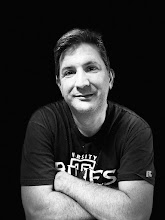
"I have been interviewed by David on a couple of occasions and found him to be a professional in every sense of the word. As a writer, he has the ability to make the interview feel like a normal conversation and then portray it perfectly into a story that grabs people's interest. In my experience working with David, he always uses the quotes in the perfect context and always made me feel good about how I was portrayed. I would absolutely work with David again if the opportunity ever presented itself."--Brian Martin, former KU basketball standout and NBA player, on Aug. 27, 2014.
That was so kind of Brian to write. We stayed in touch over the years, and when I posted something on Ron Kellogg on LinkedIn over a year ago, Brian wrote something like: “I played with Ronnie for two years at KU. If there was a 3-point line, he would have scored 50.” That might not have been the complete direct quote, but it was something along those lines. Brian was deeply committed to his family, his faith, and loved KU basketball passionately.
Here is what his obit read:
Brian L. Martin, 62, Business Development with Equity Bank, passed away Friday, August 15, 2025.
Memorial Service will be at 11:00 am, Friday, August 22, 2025, at Ridgepoint Church. Services will be live streamed and available for viewing by clicking the “Watch” button below.
Brian played basketball at KU from 1981-1984. He had a 10 year professional career including the NBA, CBA, and European leagues. He continued to be an avid KU fan. He enjoyed playing golf and taking care of his yard, but his favorite thing was spending time with his family and always supporting them in anything they did.
Brian was a former member of the Wichita Rotary Club and looked forward to his Men’s Bible Study each week. He will be remembered for his generosity, faith, and leadership.
Brian is preceded in death by his parents, Malty and Wanda Sue Martin. He is survived by his wife, Jodi Martin; daughters, Alissa (Erik) Kusnerus, Emily Martin; son, Alex (Shellby) Martin; sister, Debbie Bush; brother, Keith (Janis) Martin; grandchildren, Braylon Martin, Aiden Kusnerus, and Ella Kusnerus.
Memorials have been established with: Victory in the Valley, 3755 East Douglas, Wichita, Kansas 67218 and Children’s Mercy, 2401 Gillham Road, Kansas City, Missouri 64108.
Services in care of Downing & Lahey Mortuary – West Chapel.
My prayers go out to his lovely wife, Jodi, and Brian’s entire family. I feel so bad that I’m late in posting my tribute to Brian, but I just somehow missed the news when he passed. I fondly recall playing in a pickup game with Brian and his college roommate Mark Ewing at Robinson Gym around 1987 or 88 as I recall, somewhere around then. We were all on the same team and I remember Brian at 6-foot-9 leading a fast break and passing to me. I remember he was very humble and kind.
Brian made a profound difference on people’s lives, including mine. Maya Angelou said it best: “I’ve learned that people will forget what you said, people will forget what you did, but people will never forget how you made them feel.” Brian, I do remember what you said, but above all, I remember how you made me feel good about myself, that I was always very important, you made me feel very special and your spirit lives eternally. Rest in Peace my friend!
Here is that wonderful Where Are They Now? story on the great Brian Martin in Jayhawk Insider, who never saw a blocked shot he didn’t like. I know you’re now blocking lots of shots in Heaven and bringing a ton of smiles to people’s faces.
By David Garfield
Brian Martin never dreamed as a child growing up in Wichita that he’d someday play in the NBA, hold Kareem Abdul-Jabbar to one-of-four shooting, eat nachos with jack Nicholson at the Forum in Los Angeles, or travel around the world playing professional basketball.
But he did.
The former Kansas basketball player never really cared much for the game until his sophomore year in high school, when he grew to 6-foot-5. However, by the summer after his junior year, Martin became a national name at the prestigious Five-Star basketball camp.
“I dove for a loose ball in the all-star game and landed in Bob Hill’s (Kansas assistant coach) lap,” Martin said. “The first time I met Bob Hill, he told me that the coach sitting next to him said, ‘You guys are going to be pretty lucky if you can get that guy out of Kansas.’ He goes, ‘Who is he?’ ‘That’s Brian Martin from Wichita.’”
Martin, who had academic difficulties in high school, actually went to Hutchinson Community College for one year before embarking on his KU career. He was basically a 6-foot-9 role player for three years backing up guys like Kelly Knight and Greg Dreiling. As a senior, however, he noticed some NBA scouts like George Irvine of the Indiana Pacers coming to practice late in the year.
“Coach (Larry) Brown said they were looking at me,” Martin recalled. “It really surprised me.”
After KU lost to Wake Forest in the second round of the NCAA Tournament, Indiana eventually selected Martin in the ninth round of the NBA Draft. He was cut just three days into rookie free-agent camp. However, like his high school coach, Brown, and former KU coach Ted Owens, Irvine saw a raw shot-blocking talent who just needed some seasoning and motivation. He told Martin to go to the CBA and “work on your game and see if you got a chance to play, because I really think you do.”
Martin played for Tampa Bay Thrillers’ coach Eric Musselman, a master motivator whom the ex-Jayhawk called the “most eccentric, different coach I’ve ever played for" (he once gave death threats to an opposing player during the CBA championship).
"He said, ‘You’re not going to play at first, but bide your time, and by the time the playoffs start, you’ll probably be starting,'" Martin remembered.
Sure enough, Martin was in the staring lineup six games before the playoffs began. All he did was help lead the Thrillers to the CBA championship, and wound up as the leading shot blocker and rebounder in the playoffs.
“It must have been the (career) turnaround,” Martin said.
Martin followed his stellar CBA playoffs by making the Seattle Supersonics’ opening-day roster the following season.
“That was obviously a dream come true,” he said.
Martin was with Seattle for a month before being released and sent back to Tampa Bay. And then, the Portland Trail Blazers picked him up in January. Martin, who finished the season in Portland, will never forget playing the Lakers in the Forum. When he first stepped on the court, Martin turned around and saw “Kareem standing right next to me. He’s 7-2, one of the greatest players ever. I thought, ‘This is pretty cool.'"
Martin, who held Jabbar to just one-of-four shooting in the second quarter, was proud the legend “just didn’t go off on me.”
And then there was famous actor and rabid Lakers’ fan Jack Nicholson, who sat eating nachos and drinking a beer next to Martin by the Blazers’ bench. He said, ‘Do you want a nacho?’ I said, ’Sure,’ so I grabbed one of his nachos. He said, ‘Do you want a beer?’ I said, ‘No, I better not do that.’ He gave me that Jack Nicholson smile, which just cracked me up.”
After his stint in the NBA, Martin spent the next two years playing in Spain and Belgium. He returned to the CBA in 1989 and played for three different teams before going back overseas again to Germany for two years. Martin came back to the CBA with Omaha and Fort Wayne before getting burned out and retiring from basketball in 1994.
Martin, who played in two CBA all-star games and led the league in rebounding and blocked shots three years, finally decided to get a “real job” and became a sales representative for an awning company in Denver. He got a better offer in 1997 and moved to Salt Lake City, where he’s been the sales rep and assistant general manager for Allied Awning and Sign the past three years.
After playing basketball so long, Martin admits he initially suffered “quite a shock to the system” entering the “sedentary” business world. This once unknown player from Wichita now has his hoop dreams centered on his 2-year-old son, Alex.
“I miss playing, but it’s been five or six years now,” Martin said. “I kind of joke that he’s my 401K plan. I got him shooting jump shots on a six-foot goal already. I’m working him hard.”
A Closer Look at Brian Martin:
Years at KU: 1981-84
Career Notables: Finished career as fifth-leading shot blocker in school history (83)…only player to block a Wayman Tisdale shot in 1982-83…Career-high 18 points against Ohio State on Dec. 22, 1983.
Education: Martin majored in film studies.
Family: Martin and his wife, Jodi, have three children (Alissa, 11, Emily, 7, Alex, 2)
Hobbies: Golf
Since Leaving KU: Martin played a year in the CBA with the Tampa Bay before making the NBA in 1985-86 (Seattle and Portland). He spent part of 1986-86 with Tampa Bay, and the rest of his career playing overseas in Belgium, Spain, and Germany and with five different teams in the CBA. Martin also had stints in the USBL, Canadian Basketball League, and Italy. He retired from basketball in 1994, and became a sales representative for an awning company in Denver.
Currently: Martin is a sales rep and assistant general manager for Allied Awning and Sign in Salt Lake City, Utah (since 1987)
Favorite KU Memories: Having a run-in with Indiana coach Bobby Knight after KU beat the Hoosiers, 71-61, in Madison Square Garden in 1981. “He was fuming and yelling at an official. I said, ‘That’s what you get, coach.’ He turned around and just glared at me. His assistant coach goes, ‘You don’t talk to Bobby Knight that way.’…I’ll never forget that look he (Knight) gave me. I thought he was going to hurt me. It was pretty funny.”
On the Jayhawks Today: “I can see them as a possible Final Four in the next year or two…I’m still proud of the team, and proud to say I played for them.”
Here, Brian talks about his childhood, how he began playing basketball, idolizing Jack Sikma in high school, and then a funny story about signing autographs when he played for the Seattle SuperSonics with Sikma.
"(I attended) Hutchinson Community College (for one year). That was more because of my grades. I just didn’t try hard enough in high school. I needed a year to get myself together. The nice thing about it... I had- gone to KU the first of the year in 1980-81. We were finding a technicality with my grades. I don’t actually remember the whole thing. If you counted a certain number of hours, I was OK. But they filled in these other hours that I had missed just barely. So we appealed that to the NCAA, and so while we were waiting, I was at KU for about a month. They denied the appeal. I had to go to Hutch. It was nice because coach (Ted) Owens sad, ‘Well, just go down there and get your grades together and come next year. As a matter of act, when I grew up, I didn’t care anything about Kansas or Kansas State. My dad grew up in Oklahoma, so I was always an Oklahoma football fan. We were right on the Arkansas border (Fort Smith, Arkansas), so Oklahoma and Arkansas were the teams I kind of followed when I was a kid. Until I started getting recruited, I didn’t really think anything about it. I grew up in Wichita. We moved there. My mom and dad both grew up in Oklahoma and Arkansas… I didn’t start playing basketball until I was a sophomore in high school. I was always tall. I was 6-foot in the eighth grade. I just never cared to play. My dad played. He was great; he never pushed us (and said), ‘You got to play’. (I loved) swimming a lot. I was tallest of all the guys around. They said, ‘You got to play basketball. You got to play basketball.’ I started throwing the ball around that summer, kind of throwing it off the backboard and catching and throwing it down and shooting and just playing games with the guys. I started liking it. I tried out for the sophomore team my sophomore year and made it. We won the city championship. It kind of took off from there. I really started liking it.
"They built Northwest High School in Wichita for my junior year. I went to West High School my sophomore year. So everybody from that sophomore team went to Northwest. We stayed together. The JV coach at West became the varsity coach at Northwest. He got us going and kept us together. The summer between junior and senior year, he got us on the weights. I think that’s when I probably got serious about it. I went to Five Star basketball camp. I made the all-star game there. I played against against Tim McCormick (Michigan star center and eight-year NBA player), Karl Papke from Wichita, he was there. That’s when I found out that I was actually pretty good. That’ s where most of the colleges saw me. That’s when I started getting recruited. In fact, I dove for a loose ball in all-star game and landed in Bob Hill’s lap. He had no idea who I was...Bob Hill remembers that, and the coach sitting next to him says, ‘You guys are going to be pretty lucky if you can get that guy out of Kansas. (Hill) goes, ‘Who is he?’ Someone clued him in. ‘That’s Brian Martin, he’s from Wichita. Bob Hill’s like, ‘Wow, I didn’t know who you were.’ I landed right in his his lap diving for a loose ball. Obviously, they made some contact with me. The first time I met Bob Hill, he told me that story. I said, ‘I remember landing in your lap.’ He said, ‘Yeah, I did, too, because I had no idea who you were.’
“… I used to always pretend to be Jack Sikma (Hall of Famer and seven-time NBA All-Star) in high school. A teammate of mine in high school loved Seattle, so we ‘d always be Seattle. It was kind of neat. When I was on Seattle’s team, my high school teammate called. He wanted me to get Jack Sikma’s autograph for him. ‘So Jack, do you want to give me your autograph?’ In fact, we were at an exhibition game. We were playing Portland somewhere in Oregon. I don’t remember where. It was a high school gym or small college gym. I always put my sweatpants on, my warm-up pants, and my jersey on to go out and shoot before the game, and an hour before the game or half hour before the game, as I was walking out, all these little kids were coming around wanting my autograph. There were about 30 kids around me and I was signing autographs. All of a sudden, I was in a middle of an autograph, this kid just ripped it out of my hand, and the whole crowd just left. I turned around and Jack Sikma had walked into the gym. They all wanted his autograph. They didn’t know who I was. So he just ripped it right out of my hand. I think I got like the first three letters of my first name in. I was like, here I was feeling pretty special, like I was a stud, and here (Sikma) walks in and puts me in my place.”