Showing posts with label Donnie Von Moore. Show all posts

Friday, December 17, 2021

Former KU teammates and Max Falkenstien Blast Darnell Valentine


Darnell Valentine culminated his magical and tremendous career in 1981 as KU’s No. 2 all-time leading scorer (1,821 points) behind Clyde Lovellette, the school’s all-time assist leader with 609, while also ranking first in steals with 336 and free throws made (541).

Forty years later, his steals and free throws made still rank No. 1, while he is No. 7 in scoring and No. 6 in assists.

Valentine, a second-team AP All-American his senior year in 1981, averaged 15.4 points, 5.2 assists, 2.8 steals and 3.6 rebounds in 33.1 minutes per game over 118 contests during his career, while shooting 47.6 percent from the field and 71.8 percent at the free throw line.

He is the only player in Big Eight history to be named first-team All-League four years, while also selected as a three-time Academic All-American. He achieved a 3.3 GPA in pre-law.
 
Valentine received the ultimate honor when his No. 14 jersey was retired for eternity in the hallowed Allen Fieldhouse rafters on Dec. 1, 2005 at halftime of the KU-Georgia Tech game.
 
“This is large, this is an incredible opportunity for me just to come back,” Valentine said before the game. “This is like the crowning moment for me. I don’t know how involved, or what my presence will be from this point forward, other than another time for them to recognize me. This is the crowning of my adult life right now.”
 
Asked about it taking 24 years since he left KU for his jersey to be retired, Valentine gave an eloquent reply.

 “I was just looking at the media guide. There was a gentleman in 1927 whose jersey was retired in 2002. I forget this name,” Valentine said. “That was a great era. ... Jo Jo, he left here in ‘69. His jersey wasn’t retired until 2001. It seems like 24 years is a nice place. I can certainly appreciate it and I can relish that it is happening now and come back and be excited about it and fully appreciate what it means.”

 D.V. definitely has a special place in his former KU coach Ted Owens’ heart. He couldn’t have been more elated to see his jersey retired.

 “Darnell Valentine is one of the greatest players we’ve ever had here,” Owens told the Jayhawk Radio Network on Jan. 1, 2005. 

“It’s a wonderful day. To see him honored is a blessing for all of us.”
 
Despite all of Valentine’s accomplishments, he also had critics. Former teammates Donnie Von Moore and Tony Guy blasted Valentine during interviews with me many years ago. 

"Darnell Valentine, he was supposed to be the Academic All-American and all that crap, but (he got) a general studies degree,” Von Moore told me in 2000. “They don’t talk about that. I’m not saying there’s nothing wrong with a general studies degree if you know what you’re doing with it, if there’s an interest in it or something that you really want to do. But it can be used for something negative, too, to get you a lot of easy, bullcrap classes that don’t amount to a hill of beans. You get your degree and you go out there...(They find out) you took basketweaving one through eight for 20 hours. I kind of blew the whistle on that. Mike Fisher (KU academic counselor), he kind of took the fall for all that. That was a big story. It kind of led to Ted Owens being fired. He was pissed off at me for a long time. Ted didn’t speak to me for about 10 years because it kind of blew the lid off the thing.”

Von Moore was just getting started in firing criticism at Valentine, whom he played with for one year in 1977-78 when Donnie was a senior and D.V. a freshman sensation. KU won the Big Eight championship, but Final Four dreams were crashed when Kansas lost to UCLA in the first round of the NCAA Tournament. I cried after the loss having dinner with my parents. This was one of my all-time favorite KU teams and I got chills every night in Allen Fieldhouse watching KU play next to my dad each game with our season tickets knowing I was watching the No. 5 ranked team in the land.

Darnell, Donnie, Paul Mokeski, Clint Johnson, John "The Franchise" Douglas, Wilmore Fowler...These were my childhood heroes and I loved them dearly, much more than words can show.
 
Von Moore was angry at Valentine and Owens. He said Valentine was a very selfish player.
 
“Darnell got something he didn’t deserve. He was one of the reasons we lost the UCLA game,” Von Moore said. “He tried to have a personal one-one-one contest with Hamilton (Roy, star UCLA point guard). Darnell had two or three charges trying to take the man. Ted let him do it. It changed whole momentum and led them back in. (He got in) foul trouble (and fouled out when UCLA then took control of the game). (It was) stupid, so pissed off. We could have went somewhere with all the players we had.  
“They put the game in (Valentine’s) hands,” Donnie added. “Other than Darnell bringing the ball up the court, no shot. Had no jumper, no real overall game. He was just Darnell Valentine who had the ball all the time.”
 
Von Moore was so upset that he didn’t return with the team to Lawrence. Instead, he went with teammate Clint Johnson to California to stay with Johnson’s brother for two weeks before coming back to Lawrence.
 
Valentine and KU assistant Lafayette Norwood also hurt chemistry on the squad. Norwood, Valentine’s high school coach at Wichita Heights who came to KU as a package deal with D.V., was always inseparable with Valentine at KU, apart from the other players and coaches. Max Falkenstien, the legendary KU announcer, wrote about this in his 1996 book, Max and the Jayhawks:
 
“In fact, it was a strange coach-player relationship. They were always together. In airports, hotels, they were generally in tandem, separated from the rest of the team. I always questioned whether this was a good situation for team unity, but we never talked much about it.”
 
Norwood even had a picture of Valentine in his office. Owens got angry, and told Norwood to take it down, and said if he’s going to have a picture, make it be a team picture.
 
Even the great players, leaders, and tremendous people have their faults and imperfections. Valentine certainly did. He had a big ego and didn’t seem to care about his teammates. Tony Guy, a starter for four years from 1978-82 whom played with Valentine for three seasons, said teaming with Valentine was very troubling.

 “I think that Darnell Valentine was a great basketball player, there’s no doubt about it. But Darnell did not have a lot of confidence in the guys he was playing with,” Guy told Mark Stallard in his 2005 book, Tales from the Jayhawks Hardwood.
 
“It was almost as if we had to prove to Darnell that we were worthy to be his teammates. I always found that interesting, in that you’re talking about a guy who was a great athlete, but he was just an okay basketball player. I thought he was a great athlete, you couldn’t help admire him as an athlete. But as a basketball player, he was just an average shooter. If you look at the overall statistics, it’s not like he lit the place up. He didn’t pass the ball a whole lot, to be totally honest. I was a shooting guard, and trying to get the ball of out of his hands was like pulling teeth. 

 “It was interesting, because it was almost like we had to prove that we could play.”
 
This is painful to write, because I truly idolized Valentine growing up and he meant so much to me and I followed his NBA career so religiously and had pictures of him all over my wall as true inspiration. I put him on a pedestal; to me, he could do no wrong. I always thought his work ethic and defense were peerless, and he could penetrate the lane with the best.

Darnell Valentine was always my all-time favorite Jayhawk before Tony Guy replaced him in my heart as my No. 1 KU player ever.

Guy told me in 1999 that Valentine was a very egotistical player who was only concerned about furthering his career, instead of winning.
 
Guy gave an example of Ricky Ross, Valentine’s teammate in 1979-80 who was well-known to be extremely selfish with a big ego. One game, Guy told told me, Ross had a big scoring night but KU lost. Everyone was despondent in the locker room except Ross. Ricky couldn’t understand why his teammates were down after his high-scoring game.
 
“That’s how Darnell was,” Guy said.
 
However, Guy greatly admired Valentine’s defense and work ethic.
 
“I wouldn’t say we were friends,” he said. “I had a great deal of respect for that guy. The guy was an incredible athlete, his work ethic was phenomenal.” But?
 
“Darnell could have made it possible for two or three other guys to have gone to the NBA,” Guy said. “That’s how good Darnell was. That’s what Magic (Johnson) did (for Michigan State). Jay Vincent (he played nine years in the NBA) and Gregory Kelser (No. 4 overall pick in 1979 by Dick Vitale's-coached Detroit Pistons who played five years in the NBA) weren’t great basketball players. But every time time you saw them, they were dunking it. That was Magic. They were just average basketball players. Magic was about winning championships. How do you measure a great player? You measure a great player by his ability to make those around him better than they actually are. It’s about winning. Team sports is about winning

 “... Darnell was a phenomenal player,” Guy continued. “Trust me, I had to play with him every day and against. The guy was incredible. There was not a guy that I played against that I had to worry about another team’s point guard. Other than one--Larry Drew (Missouri star). One of the best players that we played against. He could shoot, but more important, he used his skills to help his team win. He could have shot more than he actually shot.”
 
Despite these critical comments about Valentine, Guy admitted that “Darnell was a lot of fun to play with. We had a lot of laughs. Had a great time with him. But we had a lot of disappointments, too.”

Former KU assistant Bob Hill, who coached Valentine all four years, was also critical of this All-American. Hill spoke to my Coaching Basketball class at KU in 1985, when I asked him who was the best player ever coached.
 
Without hesitation, Hill replied:

“Darnell Valentine.”
 
Hill, though, quickly added that Valentine wasn’t the most coachable player. He said that Valentine would break down plays at the end of the game and KU would lose. Hill added that everyone blamed Owens when it was Valentine’s fault.
 
While Valentine told the local media that he was elated that Jan. 1, 2005 day when his jersey was retired, he had a different opinion when talking to a Portland newspaper, his longtime hometown. Valentine fell in love with the Portland community and area since entering the NBA as a first-draft pick of the Blazers in 1981. 
 
“I am excited, no question,”  Valentine said. “But they retired the numbers of so many of their recent players — Raef LaFrentz, Nick Collison, Jacque Vaughn — within a year or two after they left Kansas. I think the timing for me is a little bit off, to say the least.”

 Falkenstien came close to summing it up best about Valentine’s huge ego and how it hurt the Jayhawks in his book:
 
“Darnell was a fabulous player for KU, but I felt that often he tried to do too much at the expense of the team.”
 
A longtime journalist and sports editor in Kansas once told me that Valentine had no friends on the team. However, I saw Valentine playing tennis with teammate David Magley at KU one time. Magley has also repeatedly talked very warmly of Valentine, his longtime friend who he first met on his recruiting trip to Lawrence.

As has Drew, who battled against Valentine in college and then the NBA, while also teammates with Valentine with the Los Angeles Clippers.

“He was a warrior,” Drew told me once of Valentine.

 But in the end, Guy said Valentine extremely hurt KU too often during his career. 
 
“He was very selfish and it cost us dearly,” Guy said. “He wanted to get his. When I played, Darnell was basically allowed to do whatever he wanted and whenever he wanted to do it. And it cost us. We weren’t nearly the teams we could have been under Darnell. A tremendous basketball player, but he used all of his skills to enhance his own career. That’s all he was about.”


Thursday, April 16, 2020

Darnell Valentine led KU to a magical season as a freshman in 1977-78

Darnell Valentine, the prep phenom from Wichita Heights, took a recruiting visit to North Carolina with fellow high school sensation Al Wood from Gray, Georgia, during his senior year. Valentine could see himself playing for legendary coach Dean Smith and the Tar Heels, a school with such rich tradition that was competing with Kansas for Valentine’s services.

“I was feeling very comfortable at North Carolina, and Lafayette (Norwood, Valentine’s coach at Heights) and I said, ‘Let’s go back to Wichita and sit down and gather ourselves and make the decision,’” Valentine recalled before the KU-Georgia Tech game on Jan. 1, 2005 in Allen Fieldhouse, where his jersey was retired at halftime.

However, everything changed for Valentine and KU when head coach Ted Owens soon made Norwood his assistant coach and the first full-time African-American assistant in KU basketball history.

“A week later I believe or somewhere in that space of time, they brought him as a staff member,” Valentine said. “It certainly laid things in Kansas’ favor.”

So Valentine picked KU instead of Smith and North Carolina while Wood chose UNC. D.V., a tenacious defensive player, was expected to have an immediate and profound impact after two down seasons for Kansas (13-13 in 1975-76 and 18-10 in 1976-77).

Valentine and Norwood were — and have always been — extremely tight.

“Lafayette, I don’t know if he adopted me or I grabbed his leg, but we’re attached,” Valentine said. “His family, we’re still very close.”

A reporter asked Valentine if he would have gone to Wichita State had the Shockers hired Norwood as an assistant coach.

“That’s a good one. I think he would have done very well, but I probably would have gone to North Carolina,” Valentine said. “Oh, Dean Smith and the tradition of North Carolina and the players that were there. It’s a phenomenal program, a phenomenal program. Phil Ford (star point guard) was a senior, I would have had the opportunity to learn and expand my game. That would have been incredible.”

But Valentine certainly has no regrets about becoming a Jayhawk.
  
“It’s something that I’ve never looked back on,” he said with a smile. “I’m 300 percent sure that it was the right decision to me.”

Valentine started from day one for that great and magical 1977-78 team, which was ranked as high as No. 5 nationally and finished at 24-5, losing in the first round of the NCAA Tournament to No. 2 ranked UCLA. Joining Valentine in the starting lineup were senior guards Clint Johnson and John Douglas and junior Paul Mokeski and senior Ken Koenigs up front. Senior forward-center Donnie Von Moore and freshman guard Wilmore Fowler were invaluable as the team’s Super Subs. 

That squad, which had seven players average over 20 minutes per game with Douglas a team-high 27.8 mpg, had very good chemistry after some tough years, but throughout Valentine’s career, his extremely close and unique relationship with Norwood hurt team unity. Norwood once had a picture of Valentine in his office, which upset Owens. Ted told Norwood to take the picture down and told his assistant that if he’s going to have a picture, make it a team picture.

Valentine and Norwood were always inseparable at KU, apart from the other players and coaches. Max Falkenstien, the legendary KU announcer, wrote about this in his 1996 book, Max and the Jayhawks:

“In fact, it was a strange coach-player relationship. They were always together. In airports, hotels, they were generally in tandem, separated from the rest of the team. I always questioned whether this was a good situation for team unity, but we never talked much about it.”

A source inside the Kansas basketball program at the time told me Norwood’s salary was being paid by KU boosters in Wichita. This source called these boosters the “mafia.” While Norwood was taken care of, he had other issues to worry about.

“It wasn’t all peaches and cream when I took the assistant coaching job at the University of Kansas,” Norwood told the Johnson County Community College Campus Ledger on April 17, 2014. “It just wasn’t popular to always have black coaches at that level, so I ran into obstacles of opponents and even some of our own fans.”

While Norwood tried his best to do his job with fellow assistant Bob Hill and coach Owens, KU was having a dream season. This was a balanced, senior dominated team led by a freshman phenom in Valentine with four players averaging in double figures that season. KU was paced by Valentine (13.5 ppg), followed by Douglas (12.7), Keonigs (11.1) and Von Moore (10.7), while Mokeski averaged 9.3 points and Fowler 7.0 points per game.

Each player had its role and performed it to near perfection. Valentine was the playmaker, defensive stopper and scorer; Douglas, who sacrificed his game (team-high 19.2 points per game as a junior last season as an honorable mention All-American), was very athletic who could score and defend taller players; Johnson was a defensive scrapper who never saw a loose ball he didn’t like; Koenigs was a smooth shooting 6-10 forward and good rebounder; Mokeski added great size at 7-foot who could score and defend in the low post, rebound and block shots; and Von Moore was a great shooter who could rebound and block shots off the bench. Fowler, meanwhile, added outside scoring. He was a prep phenom from Palmetto, Florida, who the Detroit Pistons considered drafting out of high school.

The high-powered Jayhawks won seven of their first nine games (eclipsed century mark in three of the first four games) with only losses to No. 1 ranked Kentucky and No. 4 Arkansas. KU then caught fire winning its next 17 of 18 games with the only defeat at Nebraska (62-58).

Leading KU’s charge was Valentine. Falkenstien wrote about his great addition:

“Although he was just one year removed from high school, Valentine was an instant hero. He arrived at Kansas and played an extraordinary role from the start. He was a tremendous athlete and was impressive in all phases of the game.”

I vividly remember going to the games at Allen Fieldhouse with my dad and getting chills knowing I was watching the No. 5 ranked team in the country and watching my heroes like Valentine, Douglas and Von Moore. To this day, that squad remains one of my all-time favorite KU teams.

KU won the Big Eight title (13-1) and all roads look paved to opening the NCAA Tournament in Allen Fieldhouse, where Kansas was expected to win the Big Eight Tournament and become the automatic qualifier in the NCAA Midwest Region. All the ‘Hawks would then need was to win two games to advance to their first Final Four since 1974.

Koenigs, a two-time Academic All-American, a longtime doctor in Springfield, Massachusetts, and one of the smartest players in KU history, raved about KU’s team chemistry.

“I think we all got along well,” he told me in a 2001 interview. “That whole season kind of fell into place. There were some good guys on that team.”

But heartbreak happened in the semifinals of the Big Eight postseason tournament in Kansas City at Kemper Arena, when K-State upset KU 87-76. Kansas had already beaten the Wildcats three times that season, but on this night, the fourth win was not the charm.

“It is very tough to beat your arch rival four times in a row, especially in that day and age,” Keonigs said.

So instead of being the automatic qualifier and having homecourt advantage in Allen Fieldhouse, the 24-4 Jayhawks were shipped to Eugene, Oregon, for a first-round matchup against heavyweight UCLA in the West Region.

It would be a tough test to get out of the first round. But KU held a 10-point lead in the second half with nine minutes left and seemed in command when Valentine picked up his fourth foul. Owens then had a huge decision to make.

“Ordinarily, I would have substituted for him, but the momentum was ours and I couldn’t allow the UCLA guards to take over the game,” Owens wrote in his 2013 book, At the Hang-Up. “I decided to leave him in the game...and on the very next possession of the ball, he was called for a charge. I must have looked like the dumbest coach in America--and I might have been. But if I had to do it over, I would do the same.”

Without Valentine in the game, the Bruins rallied and won 83-76. And just like that, KU’s magical season — a year where the Jayhawks had the talent to make the Final Four — was now over.

“I thought it was a great season,” Koenigs said. “It kind of ended abruptly.”

Valentine finished the season against UCLA with 11 points on 5-of-14 shooting and 1-of-2 from the free throw line in 29 minutes. He added six assists, three rebounds and one steal. Mokeski led KU with 18 points and 12 rebounds.

Von Moore, who posted eight points and four boards in 21 minutes, was so disgusted in the loss that he went to California with Clint Johnson and spent two weeks with Johnson’s brother before returning to Lawrence.

That loss still pains Von Moore all these years later.

“Especially after we were killing them, it was disaster,” Von Moore told me in a 2000 interview. “All those seniors. ... We lost to UCLA and had to go home.”

Von Moore was angry at Valentine and Owens. He implied D.V. was a very selfish player.

“Darnell got something he didn’t deserve. He was one of the reasons we lost the UCLA game,” Von Moore said. “He tried to have a personal one-one-one contest with Hamilton (Roy, star UCLA point guard). Darnell had two or three charges trying to take the man. Ted let him do it. It changed whole momentum and led them back in. (He got in) foul trouble. (It was) stupid, so pissed off. We could have went somewhere with all the players we had.  

“They put the game in (Valentine’s) hands,” Donnie added. “Other than Darnell bringing the ball up the court, no shot. Had no jumper, no real overall game. He was just Darnell Valentine who had the ball all the time.”

While Von Moore’s college career came to a bitter end, Valentine’s magical career was just getting started. He had an outstanding season and established himself as one of the best freshmen in the country with the likes of Michigan State’s Magic Johnson and Duke’s Gene Banks. 

The star point guard was named first-team All-Big Eight (along with Koenigs) and set a school record for steals (80), free throws made (106) and assists (130) in a season. His 13.5 points per game was also the highest of any freshman in KU history.

While Von Moore was extremely critical of Valentine, Koenigs loved playing with him.


”I think he was one of the final steps that helped us set it over,” Koenigs said. “His addition to that team was big. It was kind of a key issue and a key component. He blended in pretty well. Obviously, Darnell brought a lot to the table and helped finish off the picture and make a great contribution.”

Thursday, October 3, 2019

My tribute to former great KU assistant coach Sam Miranda

In Part II on Sam Miranda, I write about my tribute to him after he passed in 2009. This was published in Jayhawk Illustrated.

...


The news hit me hard and sharp, jolting me wide awake in the late night hours on May 29.

It was near 3 a.m. when I went online and read that former KU assistant basketball coach Sam Miranda had died of cancer the previous day at age 78. I stayed awake the rest of the evening and the next day with Miranda occupying all my thoughts, feelings, and emotions.

Miranda was not just a Jayhawk assistant under Ted Owens from 1964-77. He was a legendary recruiter and master teacher who won over recruits and players with his supreme salesmanship, enthusiasm, persistence, tireless work ethic, honesty, and demanding tough love.

I had the pleasure of interviewing Miranda in November of 2000 for a Where Are They Now? feature for Jayhawk Insider magazine. I’ve often thought of that interview the last decade and how much fun I had hearing Miranda’s recruiting stories. And I thought Sam enjoyed reminiscing about his KU days maybe just as much.

He was full of energy that night, full of life, full of love and passion for his family and Kansas basketball. While he was no longer affiliated with KU after he resigned in 1977, Miranda never once stopped believing, cheering, and supporting the school he gave his heart and soul to for 13 years.

He laughed some while recalling his recruiting stories of former Jayhawks like Rick Suttle, Roger Morningstar, Tom Kivisto and Dale Greenlee — four of my first KU basketball heroes and stars on the 1973-74 Final Four team.

These were players I put on a pedestal; they became larger than life to me as a very impressionable 7-year-old boy growing up in Lawrence. They could simply do no wrong. At the time, I gave no thought as to how these players arrived at KU or who was responsible in recruiting them. Heck, I was too young to think about that. I just watched in awe and wonder as Suttle and company drove KU on a magical ride to the Final Four. 

Years later, I became a diligent student of KU basketball history and read voraciously every book and article I could find about the Jayhawks’ past. That’s when I learned about Miranda’s influence on KU basketball, how he started the Illinois pipeline to Kansas and got Jo Jo White to sign with Kansas without ever seeing him play in person. 

Then I had the good fortune to interview Miranda and many of his former players in the late 1990s and early 2000s, and learned even more about this unsung hero of Kansas basketball.
In 2000, he was voted by a blue-ribbon Jayhawk panel as the best assistant coach in Kansas basketball history.

 “There’s been a lot of fine, fine coaches, and whomever that panel was, I appreciate their thoughtfulness very much,” Miranda told me in our interview in 2000. “That’s a fine honor when you think of 103 years of Kansas basketball, and to be selected as the top person, that’s quite a good feeling.”

Miranda’s basketball roots were planted in Collinsville, Ill., where he was Prep Player of the Year for the St. Louis metro area his junior year of high school in 1947 and named first-team All-State in 1948. Miranda, who was inducted as a player into the Illinois Basketball Coaches Hall of Fame in 1973, became a star guard at Indiana under legendary coach Branch McCracken. He earned second-team all-Big Ten honors as a junior in 1951 and was named first-team Little All-American in 1951 and 1952.

Miranda’s dribbling ability gained national acclaim; in 1950, he was selected to demonstrate ball handling skills in a General Mills educational sports film. After his senior year in 1952, Miranda toured against the Harlem Globetrotters as a member of the College All-Star team.

 He spent two years in the U.S. Army before embarking on a coaching career in the Illinois high school ranks for eight years, where he built lasting relationships and contacts with his players and fellow coaches. Miranda then became an assistant coach at New Mexico for two years before new KU head coach Ted Owens hired him as his top aide in 1964 after taking over for Dick Harp.

Miranda actually first met Owens (KU assistant at the time under Harp) for about five minutes when he was an assistant at New Mexico during a trip to Lawrence, where he was scouting the Jayhawks in preparation for the Lobos game with Kansas in Albuquerque on Dec. 19, 1963.

New Mexico won, 59-54.

“That was the biggest game and biggest win the University of New Mexico ever had up to that point by far,” Miranda said.

After that 1963-64 season, Miranda stopped at an interstate restaurant north of Chicago on a recruiting trip and picked up the paper and read that Harp had resigned and Owens was the new KU head coach.

“I just thought at the time, ‘Man, what a great break for Ted. A relatively young person to get that kind of job,’” Miranda said. “And then about four or five days later, I got a call from him in regards to (joining his staff). He wanted to recruit the Illinois and St. Louis area, where I had some success recruiting. He came out to Albuquerque and we visited a night or so. I came back the next weekend (to Lawrence) and looked around and decided to come to KU.”

Miranda went right to work, securing a commitment from fellow Collinsville native and high school All-American Rodger Bohnenstiehl, and then soon lured White from St. Louis.

He was just beginning. 

Focusing primarily in the Illinois and St. Louis area, Miranda brought in a boatload of talent from Illinois the next 13 years. In fact, the 1974 Final Four team comprised 10 players from Illinois, including seven of the top eight.

"I was from Illinois and knew it was a great basketball state," Miranda once told writer Taylor Bell of the Chicago Sun-Times. "I knew a lot of high school coaches. I figured we had to outwork people. I was on the phone every night from 7 to 10 talking to players in Illinois. We had practice on Friday afternoon. Afterward, I'd catch a flight in Kansas City, fly to Illinois, see a game, visit with parents, 
go to dinner, then fly back on a 12:45 flight to Kansas City."

Miranda simply outworked his competition. He was quite passionate about recruiting. 

“I enjoyed recruiting,” Miranda told me. “It’s a challenge. You go in a home the summer time prior to their senior year. You’re in there with all the big schools and you’re trying to be one of the five to come out and visit your school. When you walk out on a summer evening, you know if you’ve done a good or bad job. It’s an exhilarating feeling when you walk out and you’ve done a good job of recruiting and get the kid to commit and say, ‘Yes, I’ll come visit Kansas.’”

Bell said Miranda was peerless in his profession.

“Since I began covering high school sports in the 1950s, I've become acquainted with the process and some of the best football and basketball recruiters who ever persuaded a highly impressionable teenager to leave his family, friends and hometown for a name on a map that the youngster didn't know existed. In some cases, there wasn't even a name,” Bell wrote.

“Sam Miranda was the best of all. ... Miranda built Kansas into a Final Four program in the 1970s by recruiting many of the best high school players in Illinois, including Springfield's Dave Robisch, East Aurora's Tom Kivisto, Collinsville's Rodger Bohnenstiehl, Kenwood's Donnie Von Moore and Kewanee's Tommie Smith. He set the standard for recruiters who followed him. He wrote the book. Nobody worked harder. In an era where there were virtually no restrictions on recruiting, Miranda literally camped out on a recruit's doorstep. Before anyone else, he understood the two most important axioms of recruiting: 

“1. The first coach in the door usually is the one who signs the kid.
2. You must learn who will make the final decision—athlete, father, mother, grandmother, uncle, high school coach, AAU coach—and form a close relationship.”

Miranda spoke to me about that recruiting philosophy.

“In recruiting, I always thought in any family, there’s basically one person who is the key person in recruiting the youngster,” Miranda said. “You recruit the young man and then you recruit the person who is going to help (him) make that decision.”

In Suttle’s case, Miranda won over his mother’s respect. Suttle was leaning towards Jacksonville, which had been to the Final Four in 1970, before eventually signing with KU.

“I recruited him hard for three years,” Miranda said. “Finally in the end, (Suttle’s mom) said, ‘You’re going with Sam. That’s it.’ ... She just had confidence in us.”

Miranda landed White through the confidence and trust of his high school coach, Jodie Bailey.

“About the third or fourth time I was back to see Jo Jo, we’re at a restaurant talking and I’m going over why I thought he should come to Kansas and everything,” Miranda said. “Jodie Bailey was sitting there and he said, ‘Jo Jo, that sounds good to me.’ And that was it. That kind of sealed it.”
There was another reason why White signed with Kansas.

"I went to Kansas because I couldn't talk to any other coaches. I was always on the phone with Sam," Bell reported White once saying.

While Miranda was instrumental in recruiting and signing countless prospects over the years, he selflessly credited Owens for KU’s recruiting success.

“Of course, the head coach is naturally the vital guy because he’s got to make an impression,” Miranda said. “I don’t care how good an assistant coach is in recruiting, if the head coach doesn’t make a great impression, it’s going to be hard to get the kid. And Ted always did a great job recruiting.”

With his fierce coaching personality, Miranda was the perfect blend to Owens. As former Jayhawks like to say, Owens was the nice “good cop,” while Miranda played the “bad cop” role.

“Owens was the nice guy that tried to be mean,” Morningstar said. “We all kind of laughed at. Coach Miranda, you never looked at crosswise. He had the fear of God in all of us.”

But he also had the unyielding respect and love of all his players.

Just ask Morningstar.

“He was a great guy and meant so much to a lot of us,” Morningstar wrote me in an email after Miranda’s death.

Just ask former KU center Roger Brown.
 
Brown was one of countless post players who made huge strides under Miranda’s tutelage. Brown credits Miranda, who worked primarily with KU’s big men — as a key factor in his development.

“He said (during the recruiting process) he was going to be out there every day working with me,” Brown said during an interview in 2002. “I didn’t take him seriously. I just took it in passing, but when I got there and realized how intense he was as a coach and that he was true to his word, I said, ‘OK, then.’

“He spent a lot of time with me and Dave (Robisch) every day. I think that was a big factor in my development. I think that was a major thing that he gave attention to all the players, especially the big men.  I think that was instrumental.”  

Just ask Von Moore.

“If it wasn’t for Sam I would not have ever gotten off the bench at Kansas,” Von Moore commented last April in Suntimes.com after a story on Miranda. “I can still hear those familiar words: ‘Don't you think we should put Donnie in the game.’ Every time he said it Ted would put me in the game. He taught me how to play the game and believed in me. But most importantly he taught me honor, dignity and respect. He was my role model and I carry a part of him with me to this very day. When I coach and when I teach. 

“What a gift. Thanks Sam.”

Just ask Greenlee.
“Sam Miranda is one of the finest men I have ever known,” Greenlee commented in Suntimes.com in May. “I had broken my ankle my senior year of high school playing football, so all of the colleges that had been recruiting me for basketball backed off. My high school football coach in Rockford, Illinois, Bill Swaby, grew up with Coach Miranda in Collinsville, and got Sam to take a look at me. Coach showed faith in me and allowed me to come to KU for a fantastic four years of my life. Best break I ever had. Thanks Coach Miranda, for everything. 

“You're the best!”

Just ask Bohnenstiehl.

“Sam was a great man to play for,” Bohnestiehl said during an interview in 2003. “He made you work. He was very disciplined. You had to work hard.”

Just ask White.

“Ted is like a second father to me, he and coach Miranda,” White said after his jersey retirement ceremony at Allen Fieldhouse in 2003. “They (Miranda and Owens) were more than just coaches. 
They were friends to us, they were our confidant. Our relationship continues on, far beyond the KU days.”

Indeed, many of Miranda’s former players kept in touch and met with him when they visited Lawrence. Miranda cherished the lifetime relationships he built with his players and was so proud of their post-KU accomplishments.

 “I think the association with the players is probably the most important thing for any coach, really, particularly after your finished coaching,” Miranda told me. “The players that you do get and how they perform and how they work hard and how they do a great job for the university and their teammates is always something to reflect and look back on.”

“(It’s a) good feeling to see the guys go on and be successful in sports and out of sports.”
After the 1976-77 season, two Final Fours (1971 and ‘74) and 23 years in the coaching profession, Miranda left KU and went to work for Maupintour Travel. He was an outside sales manager for 17 years before retiring in 1994. 

He lived in Lawrence ever since with his wife, Polly.

“It’s been a very satisfying life,” Miranda said in 2000.

Miranda left an indelible impact with everyone he met along the way. One reader of the Respublica.com captured the sentiments of all who knew Miranda with a comment on the Illinois community blog’s website after Miranda’s death.

“Every basketball town, every town, deserves a Sam, but too few have them.”

Saturday, June 8, 2019

Donnie Von Moore persevered through illness while having a standout KU career


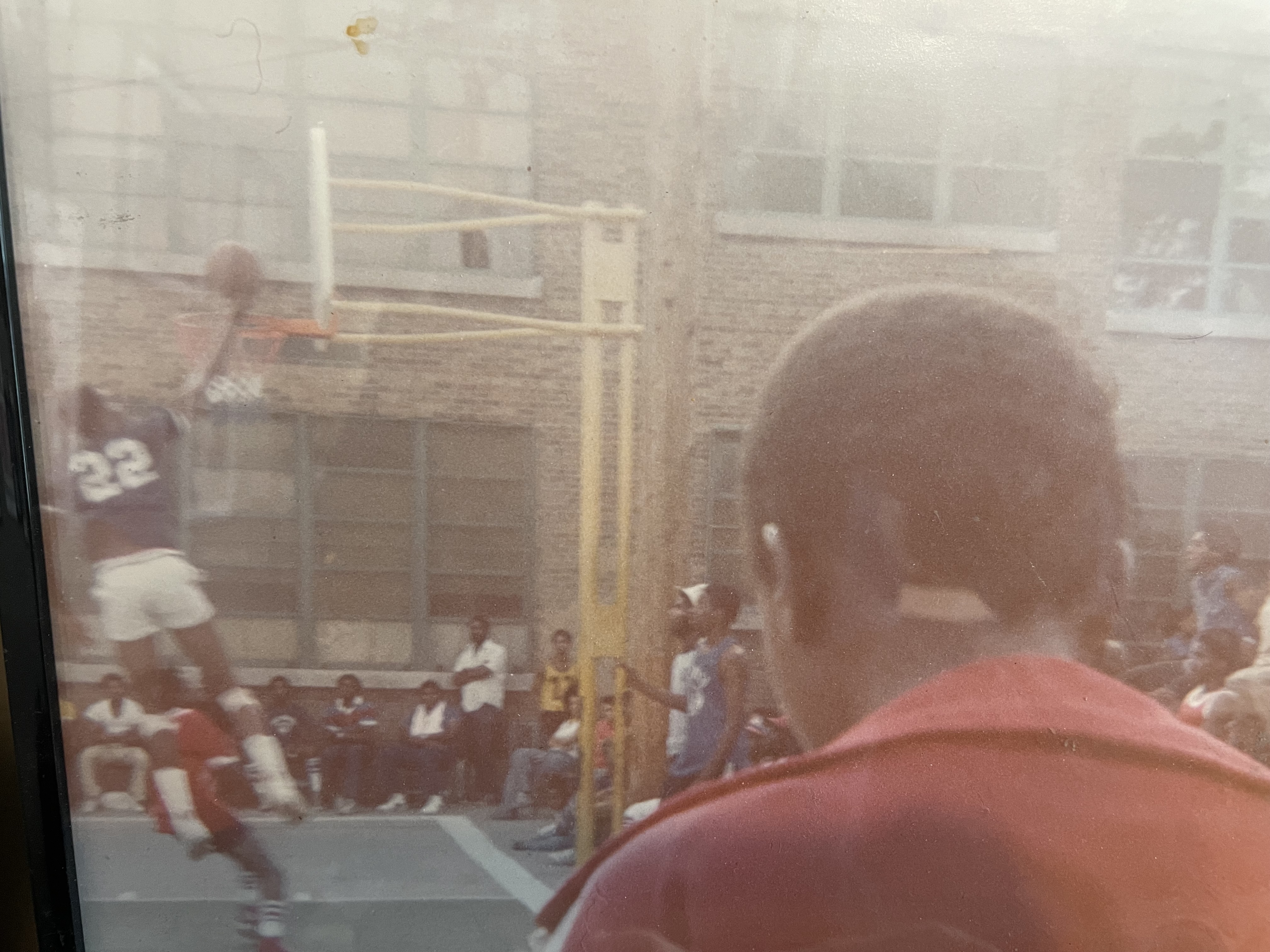
                                              Donnie, my beloved childhood hero, dunking on the Chicago playgrounds. Courtesy of my brother, Michael Garfield


Donnie Von Moore was one of my true KU basketball heroes growing up in Lawrence. I loved his name, I loved his game, and I loved his personality. Above all, I so admired how he persevered over great adversity after almost dying of pneumonia in 1975. He lay in a hospital bed for eight weeks fighting for his life.

Within two weeks of leaving the hospital and despite losing 45 pounds on his already slender frame, Donnie was back on the court practicing with his teammates. 

 “Just because you love the game so much, you got to get back into it,” Von Moore told me in 2000.

He redshirted the 1975-76 season due to his illness, but came back his final two seasons and played productively as a key reserve big man off the bench.

I’ve always had a soft spot in my heart for Donnie Von Moore. I named my intramural softball team the “Donnie Von Moore’s.” We may not have been that great, but we played with the great heart and courage of Von Moore.

I also have a connection with Donnie through my older brother Michael. My brother attended the University of Chicago in the late 1970s and lived near Wrigley Field. He would hang out with Donnie playing pool and watching him play hoops on the playground. My brother sent me this prized pic (above) of Donnie skying high for a dunk many years ago, a picture I deeply cherished of my childhood hero.

I spent about 45 minutes talking to Donnie in 2000, just before he was set to work his graveyard shift at UPS. After years of trying to find himself after KU in his native Chicago, Donnie finally got hoops out of his system at age 35 and that basketball was now “dead.” At the time of this great interview, Donnie was also working as a substitute elementary teacher in Chicago, rekindling his love for teaching that he dreamed about as age 5 and teaching life lessons to the next generation of heroes.

I’m very proud of how Donnie’s life has turned out after graduating from KU in 1980 with a degree in health education.

After averaging just 2.0 points in 13 games during the 1973-74 Final Four season, Donnie greatly improved as a sophomore and averaged 7.1 points in 20.6 minutes per game, while collecting 5.7 rebounds and blocking 37 shots. After redshirting, he came back his junior year in 1976-77 and again averaged 7.1 points in 22.7 minutes per game, while shooting 49.4 percent from the field and pulled down 5.5 rebounds and led the team with 51 blocks.

Von Moore also led the ‘Hawks in rebounds 13 times as a sophomore and junior.

The 6-9, 205-pound forward saved his best season for last as a senior on the 1977-78 team, one of the most underrated squads in KU history, which went 24-5 and was ranked as high as No. 5 in the land. I got chills going to games that season with my dad and seeing the No. 5 ranked team in action and watching heroes like Von Moore, John Douglas and Darnell Valentine living out my childhood hoop dreams.

Von Moore averaged a career-high 10.7 points per game while blocking a career-high 53 points and averaging a career-best 6.5 boards per game while recording a career-high 22 steals.

For his career, Von Moore scored 730 points (7.5 ppg) and totaled 518 rebounds (5.3 rpg), while posting 147 blocks, No. 6 all time after leaving KU.

Von Moore came to KU after a highly decorated career at Kenwood High School in Chicago, where he was a prep All-American and recruited by KU assistant Sam Miranda. Donnie was also all-state and all-city. He led Kenwood to a 21-5 record his senior year, averaging 24 points and 12 rebounds per game.

Donnie, thanks for the memories. Your great heart, spirit, soul, determination and perseverance will live with me forever!

Here is the Where Are They Now? profile I wrote on him for Jayhawk Insider in 2000.

...


By David Garfield

Donnie Von Moore lay in in a hospital bed for eight weeks in November and December of 1975 fighting for his life. Von Moore, who underwent major surgery to remove infections in his chest cavity (caused by pneumonia), was comforted and overwhelmed throughout his illness by the tremendous outpour of support from the Jayhawk community.

“In a way, it was probably one of the things that happened that was negative as far as my career was concerned,” the former Kansas basketball standouts said this recent evening from his home in Chicago, Ill. “But it was positive, because it really showed you how much people cared about you. I received thousands of cards and letters. People I never knew came to visit me.”

His family and friends, as well as his positive attitude, helped in Von Moore’s recovery process.  In fact, Doug Murray (son of Nancy and Jim, a longtime KU women’s basketball statistician), who was just 12 at the time, “almost went into the surgery with me, and then when I came out, it was his voice that woke me up.” 

Despite losing 45 pounds, Von Moore left the hospital and was back on the court practicing with his teammates in two weeks. 
 
 “Just because you love the game so much, you got to get back into it.”

A survivor, Von Moore has always been passionate about basketball and people. It was inspirational people like the Murrays and Sinclairs (Paul and his wife were cooks at the training table) which Von Moore remembers most today.

 Ironically, two of his most vivid game memories are ones he wish never happened. Von Moore, a 6-9 forward-center, now recalls the time he got into a “prize fight” with Missouri forward Jim Kennedy.
 
“The ref walked up to Ted (coach Owens) and said number 22 is out of the game,” Von Moore said. "Ted asked me, ‘What did I do?’ I said, ‘Nothing.’ When I saw the film, I was like, ‘Man, you can actually see what you did.’ I hit that guy about four or five times. It didn’t seem like I had done any of it. It was just a reaction.”

And then there was the infamous nationally televised game against K-State in Manhattan on Feb. 11, 1978. The Wildcat fans threw bananas on the floor in response to the KU faithful tossing hot dogs at showboat Curtis Redding when the two teams played in Lawrence earlier that season. K-State students even called Von Moore “ape man.”

“It was like total shock,” Von Moore said. “To me, it was racist. It was cruel and mean spirited. You wouldn’t think educated, college people would stoop to a level like that in response to people throwing a couple of hot dogs, saying a player is a hot dog, then turning it around and saying you got a gorilla or ape playing on your team and throwing bananas.”

KU ended up that season losing to UCLA in the first round of the NCAA tournament. Von Moore, who lost to UCLA in the Final Four consolation game as a freshman in 1974, was so upset that he didn’t immediately return with the team to Lawrence. Instead, he went with teammate Clint Johnson to California to stay with Johnson’s brother for two weeks. 

“As a freshman, you think you’ll be back (in the Final Four),” Von Moore said. “You don’t cherish the moment as much as you should.”

Now, 22 years later, Von Moore has learned to cherish the day-to-day moments which capture his imagination. He lives back in Chicago with his wife and daughter, just around the corner from where he grew up. Von Moore is beginning life over again at 45 after spending the previous 11 years representing the union members of Speigels. He was secretary treasurer when he ran for president of the union in 1998.

“I lost the election,” Von Moore said. “Naturally, I got fired. I ran against the establishment.”

Blackballed from the union, Von Moore has finally returned to his first love — teaching.  He currently works as a substitute teacher at an elementary school, as well as working the graveyard shift at UPS. 

“I’ve wanted to do that (teaching) ever since I was 5,” Von Moore said. “Everything else was just like sidetracked. I think it’s what I was meant to do. It’s something I know I’m good at it. I didn’t want to do it earlier, because I didn’t think I was ready and had enough experiences in life. Now, it’s about passing what you know on to someone else.”

Von Moore, who is hoping to get his Illinois teaching certificate, admits he “kicked around for a long time trying to get basketball out of my system.” At 35, he “gave up and said, ‘You got to get it out of your mind that basketball is dead.’ I then started trying to get my life together.” 

Soon, Von Moore says he has to go leave the house and work the graveyard shift at UPS. He is upbeat and persevering, just as did on and off the court at Kansas.

“All of the illness and coming back from that and all the other adversities in life, and just sports in general, prepares you to be strong at this period of time,” Von  Moore said  "The job I had before as a union rep, I was making six figures. Now, it’s like you're starting over at UPS making 10 dollars an hour. But you got to do it, because if you don’t do anything, you’ll just lay down and die.”

A Closer Look at Donnie Von Moore:
Years at KU: 1973-78 (Redshirted 1975-76 season due to illness)
Career Notables:  Von Moore ranks No. 6 all-time at KU in blocked shots (147)...Scored 25 points against Missouri his senior year...Member of 1974 Final Four team.
Education: B.S. Health Education, 1980.
Family:  Von Moore and his wife, Denise, have a daughter, Donese, 4. Donnie also has a son, Mathew, 13.
Since Leaving KU: Von Moore received his education degree in 1980, “bummed around” Chicago, and then worked in the warehouse for Speigels catalog company (1983-1988). He quit his position and went to work as a union representative for Speigels employees for 11 years. 
Currently: Von Moore is a substitute elementary school teacher in native Chicago, and also works at UPS.
Hobbies:  Spending time with his family.
Favorite KU Memories:  The lasting relationships built with people like teammate Reuben Shelton and members of the Lawrence community...The old Allen Fieldhouse floor. “It was bouncy so you could jump off it and do some crazy stuff.”
On the Jayhawks Today:  “I always look in the box scores and see how they’re doing. I think Coach (Roy) Williams is probably one of the best things to happen to KU in a long time.”

Saturday, June 6, 2015

1977-78 KU Team Took Jayhawk Fans On A Magical Ride

Nobody can ever replace my first true Kansas basketball love. That was the 1974 Final Four team, which captured my heart, soul and imagination as I fell in "love" with players like Rick Suttle, Dale Greenlee, Roger Morningstar and Norm Cook. But after winning its second-straight Big Eight title in 1975 and then suffering two seasons without an NCAA berth, the 1977-78 squad became my second love as an 11-year-old growing up in Lawrence and remains one of my all-time favorite Jayhawk teams.
With veteran players John Douglas ("The Franchise"), Clint Johnson, Ken Koenigs, Paul Mokeski and Donnie Von Moore returning from an 18-10 team the previous year, I knew KU could be pretty good. But with the addition of freshman phenoms Darnell Valentine and Wilmore Fowler, I thought the Jayhawks could actually be great.
Valentine was KU’s first McDonald's All-American from Wichita, a 6-2 do-everything point guard who led his Heights team to an undefeated season his senior year (the 1977 Wichita Heights team is arguably the best prep squad in Kansas history), while Fowler from Palmetto, Florida, was one of the top three high school guards in the country behind Magic Johnson and Valentine, a deadly outside shooter and phenomenal leaper. 
Fowler was so talented that fans would line up three hours before his prep games seeking autographs, and the Detroit Pistons considered drafting him out of high school, something relatively unheard of in that era. Wilt Chamberlain even called his house trying to recruit him to KU.
I remember taking the short walk up my street on 27th Terrace to the first day of school that year at Broken Arrow as a sixth grader and talking to my friends like Clark about the excitement of Kansas basketball with the heralded additions of Valentine and Fowler, and how much of an impact they could make on Jayhawk hoops in 1977-78 as one of the best backcourts in the land.
I surely thought this could be a magical year.
Despite those two fab newcomers, KU wasn't perceived as a national contender, or even a Big Eight leader for that matter.
"We were not even picked in the top three or four in the league that year," then-KU coach Ted Owens said in John Hendel's 1991 book, "Kansas Jayhawks: History-Making Basketball."
"Kansas State was heavily favored to win the league. They had a great team. They had Rolando Blackman and Curtis Redding, out of New York who was an excellent player, and a backcourt player, Mike Evans. They had a terrific basketball team and they were heavily favored.”
KU needed to make a strong run at the league title to help Owens' job security. He was on the hot seat after the 1977 season.
“He’s the best coach in the Big Eight,” Douglas said in a wire story. “He shouldn’t be fired.”
Owens and KU made a statement with a 121-65 season-opening victory over Central Missouri State. Kansas won its first five games, eclipsing 100 points three times and scoring 99 points against Fordham in the second game.
But KU fell at home to No. 1 and eventual NCAA champion Kentucky, 73-66, in a hard-fought game on Dec. 10. The Jayhawks rebounded and easily beat Saint Louis at home and then ORU in Tulsa before losing another contest at powerhouse Arkansas, 78-72, a team which would earn a Final Four berth and featured the famed “Triplets” in Sidney Moncrief, Marvin Delph and Ron Brewer.
The Jayhawks then entered the Big Eight Holiday Tournament in Kansas City, crushing Missouri and edging Oklahoma for a battle against KSU in the title game. KU trailed by 12 points at halftime before surging in the second half for a big 67-62 victory. Senior Von Moore, one of my favorite players (I once named my city-league softball team after him) who overcame a life threatening illness earlier in his career, came up big with 20 points and was named the tourney's MVP.
Kansas built its winning streak to eight with five more victories, capped off with another big win over the previously Big Eight unbeaten Wildcats at home, 56-52, on Jan. 21. The crimson and blue fans showered the showboat Redding with hot dogs when he was introduced, a foreshadowing about how Von Moore and the Jayhawks would be treated in Manhattan in the rematch.
Finally, KU lost to Nebraska, 62-58, in Lincoln four days later, but still stood at 15-3 overall and 5-1 in league play. However, Owens knew he needed to make some changes.
“Defeat is often difficult to swallow, but out of trials, a coach makes adjustments that, many times, led to future success,” Owens wrote in his 2013 book, “At the Hang Up.”
“We decided to quit juggling our lineups and committed to a set starting team and a rotation off the bench. Ken and Paul started inside, backed by Donnie Von Moore, while John Douglas, Clint Johnson and Darnell Valentine started on the perimeter, backed up by Wilmore Fowler. Others also filled the bench, including Milt Gibson, Brad Sanders, Booty Neal, Mac Stalcup and Scott Anderson.”
The Jayhawks responded with the new lineup by winning their next eight games to close out the regular season. I can remember how excited I was sitting with my dad at Allen Fieldhouse in Section 2, Row 4, Seat 3 just watching the squad warm up before the game and knowing I was witnessing the No. 5 ranked team in the country. I got chills thinking about that and seeing my heroes like Douglas, Koenigs and Von Moore lead the 'Hawks to such a memorable season.
I put them on a pedestal; to me, they could do no wrong.
Except one player. While Valentine was doing an outstanding job as floor leader, I always got mad at him for not passing enough to Douglas on the fast break. Douglas became my hero and captured my imagination the previous year, especially when he exploded for 46 points at Iowa State (that still stands as the most points scored by a Jayhawk on the road) and finished as KU's leading scorer at 19.2 points per game. He was my favorite player on the 1978 team and I wanted him to score most of the points. But I still liked Darnell, and he would eventually become my all-time favorite Jayhawk after Douglas left Kansas.
This was basically an eight-man team with seven players averaging from Valentine's high of 26.2 minutes per game to Fowler's 22.1 minutes per contest. Owens kept people happy by dividing the minutes so equally, and even Sanders contributed as eighth man averaging 3.0 points in 10.0 minutes per game.
The parts meshed well; this was a balanced and close-knit team with four players averaging in double figures. Valentine was the star who paced the team at 13.5 points and set a freshman record with 130 assists and 80 steals. The 6-2 Douglas, who was adept at guarding bigger players, ranked second in scoring at 12.7 points per game, while Koenigs averaged 11.1 points and led the team with a 60.3 field goal percentage. Von Moore, who was a great sixth man, averaged 10.7 points and 6.5 rebounds per game, while Mokeski (9.3 ppg, team-high 8.5 rpg) could be a force as well.
Johnson, a fearless hustler who never saw a loose ball he didn't like, chipped in 8.2 points while gunner Fowler averaged 7.0 points per contest.
As good as KU was, opponents tried to shut the Jayhawks down. KU was a victim of abuse when it visited Manhattan on Feb. 11 for a nationally televised contest against KSU. Hendel wrote:
"As an answer to the hot-dog bombardment in Lawrence, Kansas State students came up with a dig of their own. Several students showed up in monkey suits and, during the Kansas introductions, pelted the court with bananas and chickens, which had been painted blue. The game was delayed more than 20 minutes while the fruit and fowl was cleaned off the floor."
A classy Von Moore was the students' prime target. Donnie told me in an interview in 2000 that the K-State students even called him "ape man," and he was so distraught he doesn't recall scoring a point that game.
“It was like total shock,” Von Moore said. “To me, it was racist. It was cruel and mean spirited. You wouldn’t think educated, college people would stoop to a level like that in response to people throwing a couple of hot dogs, saying a player is a hot dog, then turning it around and saying you got a gorilla or ape playing on your team and throwing bananas.”
The move by K-State didn't help its cause; KU beat the Wildcats for the third-straight time that season, 75-63, with Douglas and Fowler scoring 18 points each. Kansas then beat Iowa State and Nebraska at home before clinching the Big Eight title (13-1) with a win at Colorado. This marked Owens' sixth Big Eight crown and the 35th conference championship since Kansas started league play in 1908.
“What a season it had been,” Owens wrote in his book. “A team picked to finish fourth in the league won the league instead and only lost a total of three games to date. Two of those losses came against Kentucky and Arkansas, teams ranked in the top five that would advance to the Final Four.
“Looking ahead, realizing the dream of winning a national championship was a real possibility with first and second round games in Wichita, the regional games in Allen Fieldhouse and the Final Four in St. Louis.”
However, at 23-3, KU still had some unfinished business looming with the Big Eight Tournament. After beating Colorado, 82-66, on Feb. 28, Kansas lost its first game to KSU that season in the semifinals, 87-76, as the Wildcats outscored KU by 15 points from the free throw line.
It was a heartbreaking loss for me, Owens, the Jayhawks and all KU fans. I remember listening to that game on the radio in our living room with Tom Hedrick calling the contest, and hearing Douglas miss a crucial 10-footer in the final minutes or so before we fell to the Wildcats, just realizing what a great opportunity we had slip away.
"We beat Kansas State three times," Owens told Hendel. "Beat them in the (holiday) tournament and beat them two other times. Kansas State finished fourth, they had a very disappointing year for them (18-11). It's just tough to beat a good team four times in a year.
"Everything was laid out perfectly for us,” Owens added. “All we had to do was win the Big Eight Tournament (and advance to Wichita and Allen Fieldhouse)... If there was ever a situation laid out perfectly from a geographic standpoint, from the standpoint of having great fan support, it was that year."
Unfortunately, the pesky Wildcats stole the party.
"They just put a wonderful game together, which they were capable of doing," Owens said. "And we just did not have a great game.”
The NCAA didn’t seed teams then, so sent the Jayhawks out to Eugene, Oregon, to begin tourney play against Pac-10 champion UCLA, while MU, which won the Big Eight Tournament, got placed in Wichita with just a 14-15 record.
"We walked through the Big Eight. We lost that one league game and we lost in the Big Eight Tournament," Koenigs told Hendel. "Had it been set up the way things are now (with seeding), we probably would have gotten a Midwest (regional), which was actually in Lawrence, but because then we got knocked out by K-State, we ended up going out west."
Owens added:
"Five of the top 10 teams in the country were in the Western Regional--UCLA, Arkansas, North Carolina, New Mexico, and us. It was loaded with great teams.”
Still, the Jayhawks headed into the Big Dance with confidence knowing they were playing well and had the stellar Valentine at point guard.
"I honestly don't think that we had a cohesiveness as a group as maybe when Darnell came," Koenigs told Hendel. "That was probably the most cohesive year. We all got along very well together.”
Koenigs talked more about Valentine and the team chemistry to me in a 2001 interview.
“It was a great team,” Koenigs said. “Things kind of clicked. There were some good guys on that team. Obviously, Darnell brought a lot to the table and helped finish off the picture and made a great contribution.”
While I wished KU opened the tournament in Wichita, I was still hyped about playing the tradition-rich Bruins in the first round. Although UCLA was a strong team which featured future NBA star forward Kiki Vandeweghe and boasted a strong backcourt with Roy Hamilton and Ray Townsend (the brother of longtime KU assistant Kurtis), I thought we could beat John Wooden’s squad and make a run to the national championship.
 
My dad and I had lunch before the game at a Chinese restaurant in Lawrence, bonding together while discussing topics like whether Von Moore could play in the NBA. We frequently talked about the chances of KU players making the NBA, and I know we were both rooting for Donnie.
"We'll know more after the UCLA game," my dad said in reference to how Donnie would play against the Bruins.
“Yes,” I said in agreement.
Owens prepared for the big game by calling some coaching friends and getting a scouting report on UCLA.
“Of all things, my friends said, don’t let UCLA get its running game going,” Owens wrote in his book. “To be certain that we stopped their transition game, I decided to send only our two big guys in for offensive rebounds and keep the three perimeter players back to try and disrupt the break. I made sure our big guys, Ken, Mo and Donnie, understood that the responsibility for offensive rebounds fell entirely on them. Our preparation went well and our practices were uplifting. The team had not lost their hopes of a national championship, even if the road was much rockier after the loss of a home-state, home-court advantage.”
Owens called the first half a “classic” as KU worked its own transition game and led 45-42 at halftime. But the Jayhawks got a rough break when Valentine was whistled with his fourth foul with nine minutes left as KU led by 10.
“Ordinarily, I would have substituted for him, but the momentum was ours and I couldn’t allow the UCLA guards to take over the game,” Owens wrote. “I decided to leave him in the game ... and on the very next possession of the ball, he was called for a charge. I must have looked like the dumbest coach in America— and I might have been. But if I had to do it over, I would do the same.”
With Valentine out of the game, the Bruins rallied and won, 83-76.
“We played well, for the most part, and scored 12 more points from the field than they did, but the Bruins had a 27-8 advantage at the line,” Owens wrote.
Not only did KU lose with the great foul disparity, but the game was also marred with legendary TV announcer Curt Gowdy mispronouncing many of the Jayhawks’ names.
I was choked with emotion afterwards. My dad tried to talk to me about the game at dinner, but I was in tears and speechless. I always felt pain when a season came to an end, but this was different. We were such a powerful and dominant team, and to see it end like this in the first round was just hard to grasp. It was — and remains — one of the saddest days of my life.
I thought we had the special players to win a national title.
For seniors like Koenigs and Von Moore, they took it especially hard.
“You’d like to have made it all the way, or at least made it a little farther,” Koenigs told me. “This was a team that could have gone far."
Von Moore found the bitter defeat even more heartbreaking.
“Especially after we were killing them, it was disaster,” he said. “We could have went somewhere with all the players we had,” added Von Moore, who felt bad for the fans and seniors.
Angered and upset, Von Moore didn't return to Lawrence with the team after the UCLA loss, but went with Johnson to stay with Clint's brother for two weeks in California before heading back to KU.
I didn't get over the loss for weeks. But after a while, I could look back on the wonderful season and take comfort in the many great memories I felt that year watching my beloved Jayhawks. And I wondered if I would ever see a KU team like it again.
This was indeed a very special squad. Valentine and Koenigs were named All-Big Eight, while Valentine was also the league's newcomer of the year (he later played nine seasons in the NBA). A dedicated student, Koenigs was a celebrated two-time Academic All-American who was the second Jayhawk ever to receive the NCAA Post-Graduate Award (he’s been a longtime doctor in Massachusetts).
Douglas, meanwhile, played part of two seasons in the NBA and enjoyed a long career overseas, while Mokeski had a 12-year NBA career.
Talent. Chemistry. Rebounding (KU outrebounded foes 41.2 to 32.9). Balance. The Jayhawks truly had it all.
"It was a great year," said Owens, who was named National Coach of the Year by Basketball Weekly.
"I think the '78 team and probably the '66 team, even though they didn't make the finals, they were every bit as good as the Final Four teams those years. They were teams, in my opinion, that had a legitimate chance of winning the national championship because they were good, and the other thing is because nobody had a (Kareem Abdul) Jabbar or (Bill) Walton at that time."
Owens added in his book: “The memories of the 1977-78 team have remained a source of joy for me, even if the thoughts of what might have been remain.”
I, too, am full of joy when thinking about this team, which I firmly believe is one of the best and most underrated Jayhawk squads of all time; it just happened to get an unlucky draw in the NCAA first round.
To Ted Owens, Darnell Valentine, Clint Johnson, John Douglas, Ken Koenigs, Donnie Von Moore, Wilmore Fowler, Paul Mokeski, Brad Sanders, and all the other players and assistant coaches — thanks for the magical, beloved and enduring memories.
I will never forget you.